
“But that’s it. Work keeps going on.”
This is the mantra of over 20,000 people who contribute to India’s woodblock printing industry and are dependant on it. The most revered place for block printing in India is the Jaipur region of Rajasthan, a place renowned for preserving old traditions. Introduced by the Chippa community in the Bagru district of Rajasthan, the tradition dates back to over 500 years. To keep an evanescing art alive for a period so long is phenomenal and insurmountable, it only does further to highlight the passion of the erudite artisans. This article celebrates the effort put into this exquisite craft and acknowledges the challenges faced by the industry. It becomes important to know of this in a continuously bustling world that glorifies fast fashion and mass produce, failing to look at the wider picture.
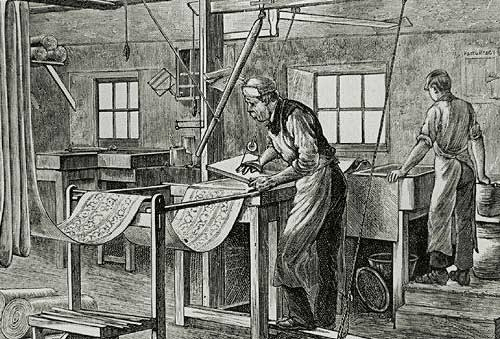
History of Block Printing in India
This sumptuous journey started in the 12th Century, at a time when hierarchy around classes still pervaded, and so did impressive cultural achievements. The method itself is thought to be 2,000 years old and adapted from China. Initially, the lavish art of printing staggering patterns on Fabric intrigued the Kings and Queens of the time. Since then, the art has been passed down to generations and evolved in the process. The major, and most miraculous, advancement that occurred as a result of this evolution was the subsequent emergence of Bagru and Sanganeri printing. Sanganer was established by Mewar’s Rajput Raja Rana Sanga in the 16th century which quickly turned into the greatest printing centre in India. Sir George Watt, in 1902, wrote “Sanganer can easily be termed as capital of Hand block printing”. These hubs still continue to thrive today, thanks to the local communities preserving the tradition over the years!
Procedure
The process itself is poetry at its finest.
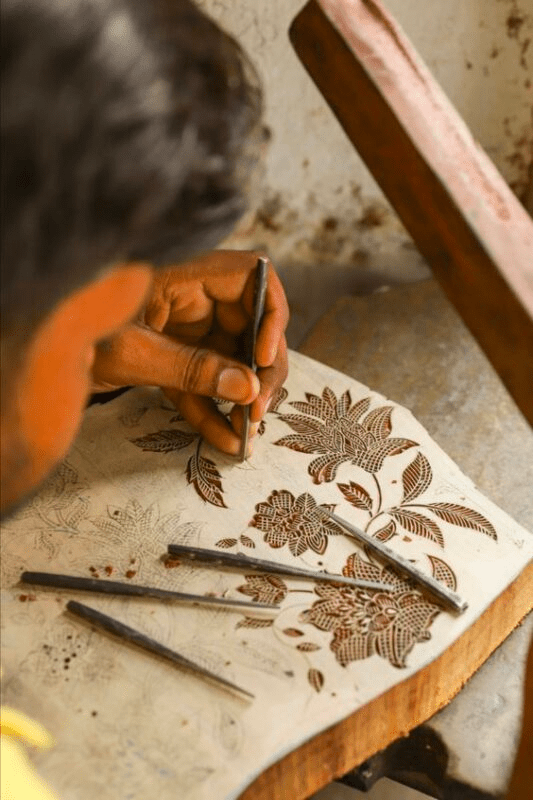
1. The artist traces out the paper drawing of the design.
The most popular types of wood for this part includes teak or mango wood. The only adversary in this process is the tediousness that comes with it. To exacerbate the difficulty, a separate block must be made for each colour. While walking around the local streets of Sanganer, one can’t resist listening to the symphony of sounds that emerge from the careful carving by block makers- the striking of the chisel, their prowess in precision, the serene echoing of subtle pounds. With limited tools, the artists create something that can’t be replicated by machinery any time soon.
2. Preparation
Before craftsmen perform a sacred sorcery on pieces of fabric, the fabric is bathed and left to dry under the brooding sun of Rajasthan. This is followed by the discernment of those working on the colours as part of the dyeing process. Lastly, a dye pad is created.

3- Block printing
The fabric is laid out across a surface. The first thing artisans do is print the outline of the design. They dip the block into the dye, carefully place it on the fabric with appropriate pressure and strike it with their hands. This creates a stamp, juxtaposing the grandeur and the simple piece of fabric. This method is repeated time and again before reaching the end result- with the fabric as a screen and the design as the film reel.
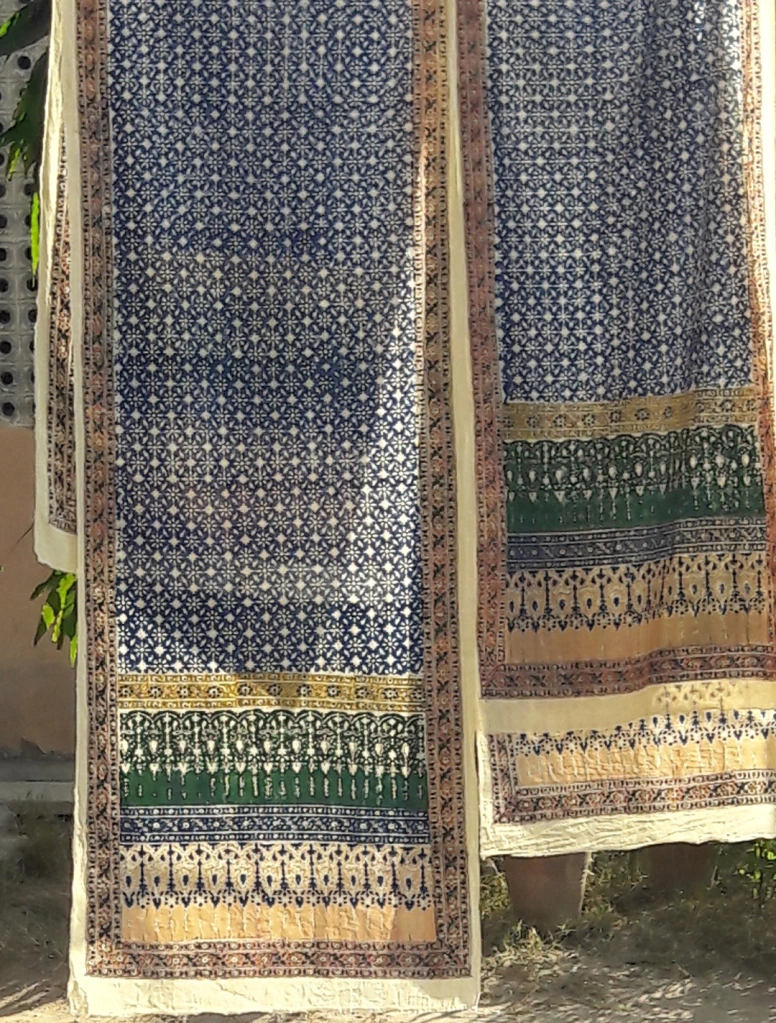
4- Final process
Just like before, the fabric is dried and subsequently sent to the local washing facility. Once checked, the completed fabric is ready to be sold around the world.
Challenges
Block printing is a direct portrayal of India’s rich culture, bustling with clandestine creativity. However, even though the process itself sounds idyllic, the industry isn’t. There are certain implications on the health of the artisans, especially prevalent in the printing process. Many artists have expressed discontent with their work and how it only serves as a poignant reminder of what their health once used to be.
“We (artisans) have suffered a lot. We used to be healthy, but today we have no good health.”
There’s several reasons for this, the most popular one being the excessively laborious job of using only hands and not machines. As stated by the Hazard Centre Report, the overwhelming amount of safety issues is a major cause of resentment amongst the workers. Due to the drastic shift to synthetics from natural materials, the inevitable exposure to chemicals has deteriorating impacts and irreversible symptoms, especially when you’ve been in the field for 12-26 years.
“No one can do this work (fixing process) for more than 25 years… it gets so hard you can’t make a fist”
It also doesn’t help that the workplaces are relatively closed, making the artisans more prone to dust. Unsurprisingly, most of these artisans eventually develop asthmatic tendencies. In addition to this, more artisans have started reporting of Musculoskeletal problems. It is unfortunate that the hand grip strength for workers in this line of industry is below normal. What makes this worse is the normalisation of injury as a part of occupation, corroborating the sense of pride in hazards. Artisans also work in dim light for long hours, resulting in eye-related problems. There is a stark lack of incentive due to limited time for experiment- as the mantra says, “work keeps going on”.
Inevitably, artisans are left feeling a sense of separation from the craft that they’ve devoted not only their lives, but also the lives of their family to. This has resulted in many of them breaking the “vicious cycle” by not passing the tradition onto their children, in favour of white collar jobs.
“I do not want my children to do this work (printing). They should become doctors or engineers.”
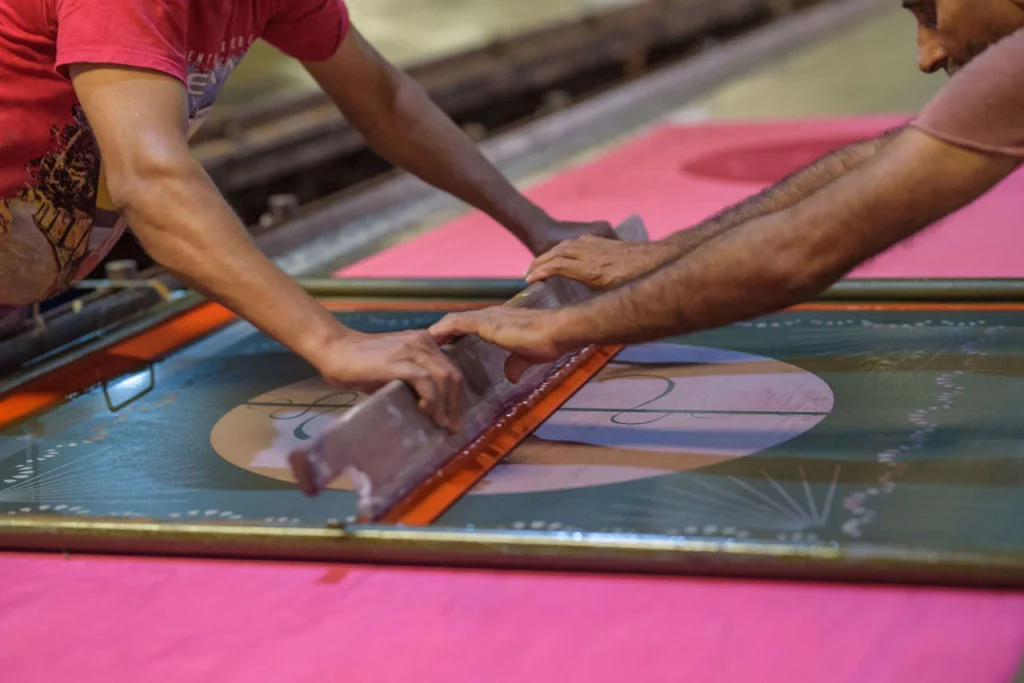
As a result of this, the supply of skilled artisans is facing a generational decline. Apart from the health-related problems, there’s an abundance of socio-economic challenges as well. The emergence of screen-printing adds to this. Contrary to the block printing method which is mostly natural, the screen-printing method promotes the excessive use of harmful chemicals. This method is preferred due to the quick and more efficient results. The contaminated water used in screen printing is too often drained into the sewage lines and then used to water commercial crops. This water comes from the screen units as well as acid.
“Our drinking water has been polluted with all these chemicals.”
The end?
When faced with this lofty mountain of problems surrounding block printing, one might ask if this marks the end of its legacy. Spoiler alert: it doesn’t. There have been continuous measures to help the industry. GST is now added to Sanganer products. This allows input tax credits on business-related purchases, helping the artisans to prosper. Along with this, the government has planted a water purifying plant (CETP) in Muhana Mod. This system is different from disposing chemical water into drains earlier. Sanganeri Hand Block Textiles and Furnishings have also received a Geographical Indication. This has provided Sanganeri textiles with increased originality and outlawed the sale of screen-printed products in the name of “Sanganeri products”. This is a massive advancement since it has paved the way for the direct employment of 1500 artists and 5000 families that rely on block printing. This has resulted in the industry slowly reviving and catching pace, accompanied with increasing popularity and appreciation for its authentic, eco-friendly nature. The Sanganer print has given the town an immense amount of recognition that should not be taken for granted.
Apart from measures by government, there has also been an overwhelming amount of organisations and local acts to help the industry further. Some of these include the Saffron Marigold, Lushfab Jaipur, Anokhi Museum of Hand Printing, Dastakar Ranthambore, All India Artisans and Craftworkers Welfare Association, and SusTex India.
Although there is still work to be done, particularly in areas surrounding the health and employment of artisans, there remains positivity in the knowledge that the block print industry in India isn’t coming to an end soon and will only continue to thrive with further initiatives.
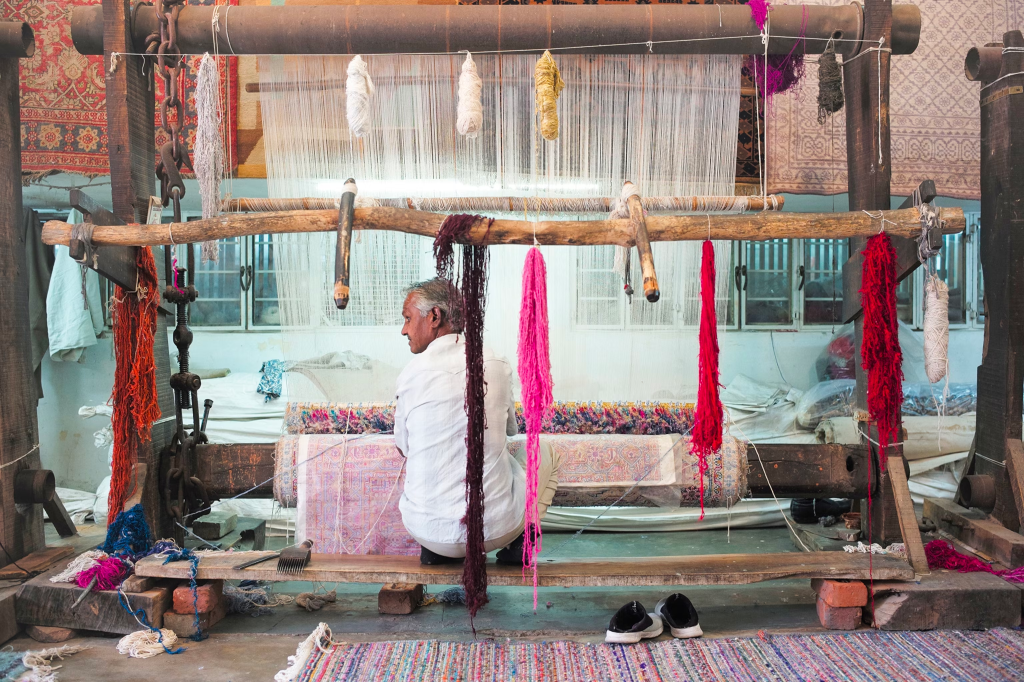
Conflicted with an ever-changing reality on one hand and a rooted sense of identity on the other, it becomes important to appreciate the ethereal art in India’s block prints and its wider representation. This serves as an effervescent reminder of the past and instills tranquility at a time like such, where all passages are just another labyrinth. Away from the dash and monotony of everyday life lies a rural nirvana worth exploring.
Fabric
-Myiesha
A benevolent tradition,
Old as hills,
Runs in blood,
Ever-ending motifs.
In a city where the sun
Hardly sees itself;
Beyond the hawks,
A world still lives.
A prodigious map,
Few rough hands;
Carving an imagery
Echoing a symphony
Like a taciturn fall,
Of reserved water on rocks.
The result is such
That one must say
“Is this the canvas
Or the paint?”
On an oasis,
The fabric faces
The brooding rays;
Must’ve been a traitor of some sort.
Meanwhile, the master
Sways the pip of spades,
Cooking colours
That ought to stay.
Then comes the most milquetoast play,
Some may say.
A meek touch,
As if one wrong move
Could burst the earth.
With his eagle-eyes,
He places the block
Onto the measured fabric.
Be rest assured,
The heel of his hands will always suffice.
A single thump, something beautiful-
The fabric now has heart, mind, and life,
Mirroring an infant’s first cry;
And then he starts anew.
On an oasis,
The infant faces
His very first rays.
Once scorched,
The evolving fabric
Undergoes one last tactic,
Where the sun sinks
Into the water.
One wrong move,
One new bruise-
This one more fatal
Than collisions and traitors.
Just like soaring swallows,
The new-found fabric
Flies hither and thither.
Be rest assured,
His wings will always suffice.
References
Quotes & research:
https://youtu.be/qZdnAz2Il20?si=kJxG6m6VFxfmcziH https://youtu.be/kM8gstdryH0?si=Xfs3ghr7KD47eol4
https://youtu.be/FHfAN1rhKrA?si=dp8vQHK5Rd9x8BLQ
Information:
https://www.saffronmarigold.com/blog/the-craftsmanship-of-indian-block-printing/ https://medium.com/@pratik.jain_3120/sanganer-print-industry-from-seeking-perpetuating-solidarity-in-an-ancestral-occupation-to-5b65822d9bcf
https://www.youtube.com/watch?v=NINMHznBNR8
https://www.youtube.com/watch?v=UcLoRBfiG1M
https://indigowares.com/blog/sanganer-block-printing/
https://culturallyours.com/2020/03/20/block-printing-art-in-india/

 The Barbaric Yawp
Leave a comment